The Eternal Frontier by Tim Flannery
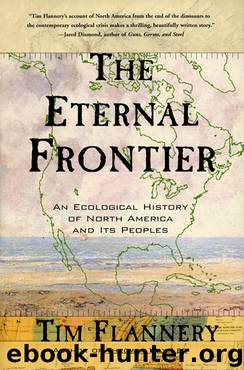
Author:Tim Flannery
Language: eng
Format: epub
Publisher: Grove/Atlantic, Inc.
SEVENTEEN
THE MAKING OF THE BUFFALO
With the end of the Clovis culture about 12,900 years ago, America's first human frontier closed. The first pan-North American culture had vanished and the varied Indian cultures to which it gave rise would live within the bounds of a diverse yet impoverished continent. Of all the great beasts that fed the Clovis people, just one was still present—the American buffalo or bison—but even it was now represented by a different genetic stock and had suffered a diminution in range, for by this time it had become restricted to the great prairie of the American west. By about 12,950 years ago a group of Indians had begun to manufacture a new kind of stone point in order to exploit this resource, and in so doing would change the buffalo forever.
When President Grover Cleveland wed Frances Folsom in 1886, he unwittingly changed the way that we would think of America's first post-Clovis culture. Cleveland's wife had lived for a time in Ragtown, New Mexico. The town had been founded in 1858 as a railroad construction camp and in 1888 its citizens were so overwhelmed at the good fortune of their girl next door that they changed its name in her honour. Folsom it was from then on, which would mean little to anyone if it had not been for a remarkable African-American cowboy who settled in the area, and the discoveries he made.
George McJunkin was one of those people who seemed to be curious about everything. A childhood spent in slavery had deprived him of an education, but after being freed by Union forces in 1865 at the age of fourteen, he took up the life of a cowboy on the Crowfoot Ranch near Ragtown. There, the indomitable George got the sons of a rancher to teach him to read. He eventually became a much sought-after fiddler, an amateur surveyor, astronomer, maker of survey instruments and in time the respected foreman of the ranch. Notwithstanding these achievements, George's real passion lay in the study of natural history. Wherever he went he picked up curios that he kept in a small museum atop his fireplace. There, stone arrowheads competed for space with fossilised animal bones and the skull of a prehistoric Indian.1
In 1908 McJunkin was out breaking horses at a place he called the Wild Horse Arroyo when he spotted a large bone protruding from the side of an erosion gully. He dismounted and dug carefully around the bone, only to find that it was attached to another. McJunkin knew that he had stumbled across something important, recognising the bones as belonging to a very large bison-like creature. He returned so often to excavate his finds that the place became known as ‘McJunkin's bone pit’. In an effort to convince others of the importance of the discovery, McJunkin wrote letters to friends describing it. When he died in 1922, before a professional excavation could be organised, his friends gave him a cowboy's send-off, lowering him into his grave on their lariats.
Download
This site does not store any files on its server. We only index and link to content provided by other sites. Please contact the content providers to delete copyright contents if any and email us, we'll remove relevant links or contents immediately.
The Lonely City by Olivia Laing(4802)
Animal Frequency by Melissa Alvarez(4474)
All Creatures Great and Small by James Herriot(4322)
Walking by Henry David Thoreau(3962)
Exit West by Mohsin Hamid(3828)
Origin Story: A Big History of Everything by David Christian(3692)
COSMOS by Carl Sagan(3625)
How to Read Water: Clues and Patterns from Puddles to the Sea (Natural Navigation) by Tristan Gooley(3469)
Hedgerow by John Wright(3363)
How to Read Nature by Tristan Gooley(3341)
The Inner Life of Animals by Peter Wohlleben(3319)
How to Do Nothing by Jenny Odell(3302)
Project Animal Farm: An Accidental Journey into the Secret World of Farming and the Truth About Our Food by Sonia Faruqi(3221)
Origin Story by David Christian(3202)
Water by Ian Miller(3188)
A Forest Journey by John Perlin(3077)
The Plant Messiah by Carlos Magdalena(2935)
A Wilder Time by William E. Glassley(2863)
Forests: A Very Short Introduction by Jaboury Ghazoul(2842)
